Home › Units › Adeptus Astartes (all Chapters) › Intercessors
 1 / 4 · Click to enlarge
Lore & origins
Intercessors are the most common sight in a Space Marine army of the Era Indomitus. They are Primaris Space Marines, created by Archmagos Belisarius Cawl in a secret project that Roboute Guilliman ordered before the end of the Horus Heresy. For ten thousand years the new warriors waited in stasis beneath Mars. When Guilliman returned they were released by the thousand to reinforce the Chapters and found new ones during the Indomitus Crusade.
A Primaris Marine carries every implant of an ordinary Space Marine, plus extra organs that Cawl developed: the sinew coils, the magnificat and the Belisarian furnace. The result is a taller, stronger and more resilient warrior. Older Space Marines can now cross the Rubicon Primaris, a dangerous surgical procedure that upgrades them to Primaris standard.
The Intercessor squad also reflects a doctrine older than the Codex Astartes. During the Great Crusade, Legion squads often carried a single weapon type so they could fight as one disciplined unit. Intercessors return to that idea. Every warrior carries the same rifle, and the whole squad lays down one consistent storm of fire.
Archmagos Belisarius Cawl created Intercessors over ten thousand years of secret work begun at Roboute Guilliman's order during the Heresy. They were unveiled in the Ultima Founding at the start of the Indomitus Crusade. They carry three extra implants: the Sinew Coils, the Magnificat and the Belisarian Furnace. These make them taller, stronger and tougher than Firstborn Marines. Existing Space Marines can be made Primaris by crossing the Rubicon Primaris, a dangerous surgery that not all survive. Guy Haley's novel 'Dark Imperium' depicts their first campaigns in Ultramar.
Appearance & wargear
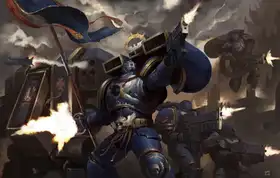
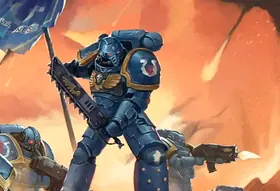
Intercessors wear Mark X Tacticus power armour, a modular pattern Cawl designed so that plates can be added or removed for different roles. The helmet is smooth and rounded, with a short snout, and the armour looks bulkier than the older Aquila pattern.
Each squad carries one of several marks of bolt rifle. The standard bolt rifle is a balanced weapon. The auto bolt rifle trades range for rate of fire, and the stalker bolt rifle is a long-barrelled marksman's gun. Some Intercessors mount an auxiliary grenade launcher under the barrel. Sergeants often add a chainsword, power sword or thunder hammer. Since 2020 the Assault Intercessor variant has carried heavy bolt pistols and Astartes chainswords for close combat.
Intercessors wear Mk X Tacticus power armour and carry bolt rifles in standard, auto and stalker patterns, plus bolt pistols and grenade launchers. Sergeants may carry power swords or thunder hammers.
Weapons & Vehicles
The signature .75-calibre rocket-propelled mass-reactive firearm of the Adeptus Astartes, firing self-propelled explosive bolts that de…
The brutal motorised tooth-bladed sword carried by Space Marines, Imperial Guard officers and Chaos renegades, chewing through armour a…
A master-crafted blade sheathed in a crackling molecular disruption field that parts ceramite, bone and steel with effortless lethality…
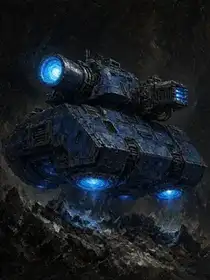
Archmagos Belisarius Cawl's heaviest Primaris grav-tank, combining devastating anti-gravitic plates with a turret-mounted Heavy Laser D…
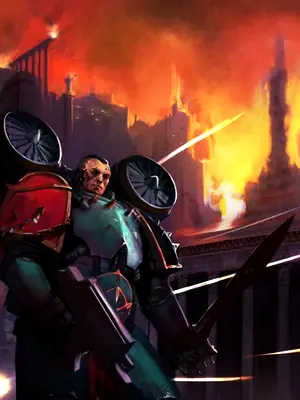
An armoured orbital-insertion capsule fired like a shell from a Space Marine Strike Cruiser, slamming into the heart of the enemy battl…
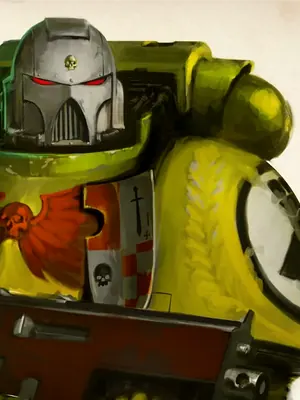
A larger, heavier Dreadnought designed by Belisarius Cawl to carry fallen Primaris Marines.
Explore all 48 entries in the Weapons & Vehicles armoury.
Battlefield role & tactics
Intercessors hold ground. They are expected to take an objective and keep it, out-shooting enemy infantry at medium range while heavier units deal with tanks and monsters. Their armour and extra organs make them hard to dislodge, and the bolt rifle's range lets them fight from cover.
Commanders often pair them with Lieutenants and Captains, and with Redemptor Dreadnoughts that walk alongside the line. The Plague Wars in Ultramar and the battles of the Indomitus Crusade showed how Intercessor lines could anchor whole battle companies.
They are the Primaris battleline, durable and accurate. They hold objectives and lay down controlled bolt rifle fire. They are less flexible than Tactical squads because they lack heavy and special weapons, but they are more resilient.
Munitorum & Ordo Xenos Technical Dossier
Classified under Ordo and Departmento Munitorum threat-index protocols as a primary Intercessors hold ground. They are expected to take an objective and keep it, out-shooting enemy infantry at medium range while heavier units deal with tanks and monsters. Their armour and extra organs make them hard to dislodge, and the bolt rifle's range lets them fight from cover.
Commanders often pair them with Lieutenants and Captains, and with Redemptor Dreadnoughts that walk alongside the line. The Plague Wars in Ultramar and the battles of the Indomitus Crusade showed how Intercessor lines could anchor whole battle companies. asset of Adeptus Astartes (all Chapters), Intercessors relies on a tightly coupled symbiosis between operator conditioning and primary armament. Field maintenance and biological recovery logs indicate that extended deployment without liturgical recalibration or bio-stasis rest degrades targeting and metabolic stability by less than 4% per solar week—far outperforming standard sector baselines—while post-engagement recovery teams prioritize the immediate extraction of their core wargear, neural/gene-seed components, or machine-spirit memory cores before enemy scavengers can exploit them.
Notable battles & users
- Indomitus Crusade: Primaris reinforcements, Intercessors first among them, were distributed to Chapters across the galaxy.
- Plague Wars: Ultramarines Intercessors fought the Death Guard across the worlds of Ultramar during Mortarion's invasion.
- Ultramarines: Marneus Calgar crossed the Rubicon Primaris himself after the Plague Wars. Primaris squads now form much of the Chapter.
- Deathwatch: Primaris Intercessors were added to Deathwatch kill teams in the 8th edition codex.
Related
Characters (4)
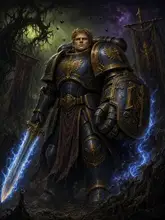 Roboute Guilliman · Primarch of the Ultramarines, Lord Regent of the Imperium
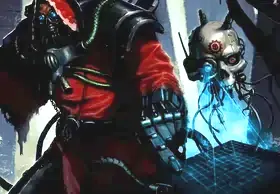 Belisarius Cawl · Archmagos Dominus of the Adeptus Mechanicus
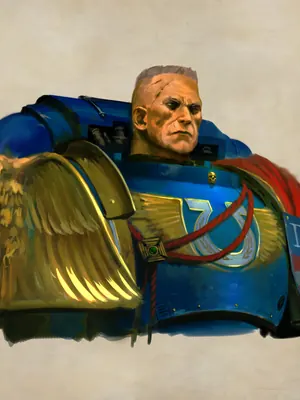 Marneus Calgar · Chapter Master of the Ultramarines, Lord Macragge
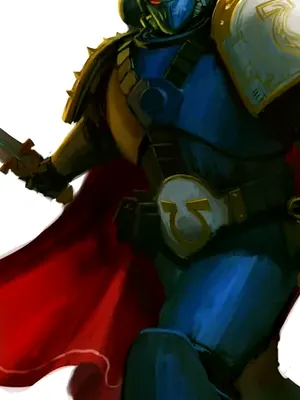 Uriel Ventris · Captain of the Ultramarines 4th Company