Home › Units › Drukhari › Incubi
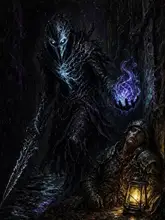
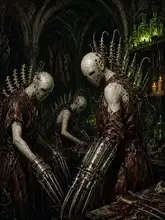
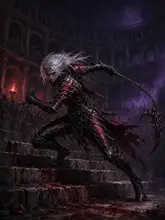
 1 / 4 · Click to enlarge
Lore & origins
The Incubi are an elite mercenary warrior order of the Drukhari, a dark mirror of the craftworlds' Aspect Warriors that has traded purity of purpose for twisted obsession and icy calm for channelled hate. They exist to perfect the killing stroke with the klaive, a two-handed power greatsword that becomes as much a part of each Incubus as his own murderous heart. They owe no allegiance to any Kabal or Wych Cult. As servants of Khaela Mensha Khaine, they are loyal first to their war-shrine. Their origins are uncertain. One legend holds that the order was founded by Arhra, the fallen Phoenix Lord of the Striking Scorpions, and some whisper that Drazhar, the Master of Blades, is Arhra himself.
Dozens of shrines are scattered across the Dark City, from towering pinnacles of black crystal to brazier-lit cavern networks. Each is ruled by a Hierarch, a mercenary warrior-king who bargains with patrons and picks initiates from the crowds of aspirants. Training is brutal. The weak are cut down and their bodies burned as offerings before the shrine's statue of Khaine, and supplicants whose pleas are rejected may be gutted and flung still living into the green fires of its pits. An aspirant who survives long enough to beat a proven Incubus and take his armour faces one last trial: to kill a craftworld Aspect Warrior in single combat and turn the victim's spirit stone into a psychic torture device, the Tormentor. Only then can they call themselves an Incubus.
In a society where rank is gained by murdering the one above you, Incubi are perfect bodyguards. They are wholly neutral in Kabal politics, they follow the code of their contract and their Klaivex zealously, and they are among the best warriors in Commorragh. Some even whisper that Incubi can be trusted to keep their word. Any subordinate who wants to replace an archon must first find a loophole that voids the contract, or face the Incubi. Unlike anywhere else in the city, assassination is forbidden within the order. Promotion goes only to those who challenge and beat the holder of the place they covet.
Appearance & wargear
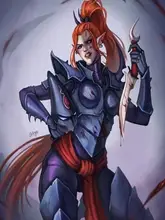
Everything about a fully armoured Incubus conveys menace. The Incubus warsuit is spiked and segmented from head to foot, and its ornate helm is framed by a pair of great razored horns that give it an almost daemonic look. The warsuit protects as well as a Space Marine's power armour without slowing its wearer at all, and the Incubi jealously guard the secrets of making and repairing it. They move with a sinuous, sinister grace, every motion humming with barely contained violence. Most carry the klaive. Some shrines prefer the halberd-like punisher, and Klaivexes sometimes carry demi-klaives, twin blades that can be clasped together into one great sword.
Weapons & Vehicles
A master-crafted blade sheathed in a crackling molecular disruption field that parts ceramite, bone and steel with effortless lethality…
The nerve-shredding neural whips and moisture-vaporising Huskblades of Drukhari Archons and Succubi, turning close combat into an arena…
The cruel crystal-toxin firearms of the Drukhari Kabals, firing storms of venomous shards designed to kill targets in maximum, soul-nou…
Explore all 48 entries in the Weapons & Vehicles armoury.
Battlefield role & tactics
Incubi serve as an archon's retinue, as shock troops and as enforcers. As bodyguards they surround their employer with a ring of flickering blades, so that he can stroll through the fiercest melee as if in the eye of a storm. As enforcers they have turned more than one pleasure den or smuggler's spire into a limb-strewn abattoir to send a message to a rival. For all their duelling skill they scorn fair fights in battle. Their Tormentor helms send out waves of neural pain before the killing begins, and rare bloodstones can boil a foe's blood from afar.
Field Modifications, Sub-Faction Doctrines & Operational Idiosyncrasies
Within the strategic threat-indices of the Departmento Munitorum, the Ordo Xenos, and the high command savants of Drukhari, Incubi are classified as a premier elites asset whose battlefield effectiveness stems from the tight integration of operator conditioning and specialized wargear. Pouring from Webway portals aboard knife-prowed antigravitic skiffs to slake the soul-withering curse of She Who Thirsts, Commorrite Kabals, Wych Cults, and Haemonculus Covens fight to maximize prolonged neurological agony. In active campaign theatres, Everything about a fully armoured Incubus conveys menace. The Incubus warsuit is spiked and segmented from head to foot, and its ornate helm is framed by a pair of great razored horns that give it an almost daemonic look.
Veteran formations of Incubi develop distinct sub-faction doctrines and field modifications over decades of continuous deployment. The craftworlds call the Incubi 'Fallen Warriors' and say their Dark Father 'turned from the light into the shadows'. This is a key reason Arhra is linked to the order. Whether fighting in void-ship boarding actions, ash-waste tank duels, or ruined hive-city basilicas, experienced crews and squad leaders strip away parade-ground redundancies to maximize ammunition feed reliability, target-acquisition speed, and close-quarters survivability under extreme suppression.
Field maintenance and biological or machine-spirit recovery logs confirm that sustained combat exacts a heavy toll on both wargear and flesh, yet Incubi maintain operational cohesion long after standard line units would collapse. Following every major engagement, recovery teams prioritize the immediate extraction of their core panoply, veterancy honors, and consecrated components so that the lineage and lethal institutional memory of the formation endure into the next warzone.
Heraldry, Battle-Damage & Community Artistry
Across the Warhammer 40,000 illustration, Golden Demon painting, and display-diorama community, Incubi stand out as one of the most rewarding subjects in the Drukhari range. Artists and miniature painters focus intently on their signature visual hallmarks: razor-edged obsidian-green, deep violet, or bone-plated armour highlighted along every cruel barb, pale bloodless skin tones, and glowing toxic-emerald vials and splinter-crystal tubes. Combined with the distinct silhouette described in field sightings—Everything about a fully armoured Incubus conveys menace—every model and canvas painting offers a rich interplay of texture between rigid armour plates, weathered cloth or chitin, and gleaming weapon assemblies.
When depicting Incubi at the height of battle, community artists and painters push contrast through sponge-chipped battle damage, directional mud and ash pigments across the lower greaves or hull tracks, and vivid Object Source Lighting (OSL) cast by active lenses, energy coils, or muzzle flashes. Sub-faction heraldry, campaign badges, and trophy details allow hobbyists to anchor each miniature or illustration in a specific canonical warzone—celebrating both the grimdark complexity of the Forty-First Millennium and the craftsmanship of the community that brings Drukhari to life.
Notable battles & users
- Drazhar, the Master of Blades: the order's silent, masked champion with demi-klaives. His name means 'Living Blade', and no one has heard him speak or seen his face.
- Morr: Incubus of the Kabal of the Realm Eternal, who led Archon Yllithian's raid to steal an Exodite girl for the plot to resurrect El'Uriaq and overthrow Asdrubael Vect.
- Bechareth: once the Incubus Kolidaran. Left behind in a raid on Alaitoc, he took a vow of silence and walked the Path of the Warrior with the Striking Scorpions.
- Shrine of Splintered Bone: carves the bones of slain foes into fetishes worn inside its warplate, pressed against the skin.
- Shrine of the Scarlet Incubi: led by the Visarch among the Ynnari.
Related
Characters (2)
 Asdrubael Vect · Supreme Overlord of Commorragh
 The Visarch · Sword of Ynnead